The Angel of Route 66


The famous Snow Cap Drive-in in Seligman, AZ.
In 1953, a resident of Seligman named Juan Delgadillo built right on Route 66 a drive-in diner he named The Snow Cap Drive-in. Not having much money, he built the place himself using scrap lumber from the nearby railroad yard. To advertise his diner, Juan cut off the top of a 1936 Chevrolet and outfitted it with painted writing, horns, brightly colored Christmas decorations and a Christmas tree sticking up out of the trunk. He drove it up and down Route 66 and when he wasn't driving it, he parked it in front of his little scrap-lumber diner. It wasn't long before business took off and The Snow Cap Drive-in has become such a success that it is now known around the world as a famous icon of Route 66.

Juan's 1936 Chevy that he cut the top off and drove up
and down Route 66 and in parades to advertise
 his quirky little establishment.
Juan had a great sense of humor which he built into the diner and even the menu which features "cheeseburgers with cheese," "hamburgers without ham," and "dead chicken sandwiches." The napkins and straws are advertised as "slightly used." The door leading into the diner has 2 doorknobs - one on each side. A glass door is locked with no doorknob and no way to unlock it - and then you notice there is no glass in the door so you can step right through. "Juan's Garden" is located in the rear - a collection of old cars, phone booths, signs, and oddly intriguing odds & ends.

Airplanes, tin-can robots, and assorted other interesting
 items adorn the Snow Cap grounds. 
Juan always had a lot of fun in life and he brought that same spirit to his business. Unfortunately for the rest of the world, Juan Delgadillo passed away on June 2, 2004. His son John and daughter Cecilia now operate the business which continues to draw large numbers of visitors to this small town which seems to be wonderfully caught in a time warp. The business cards from all over the world which line the walls around the Snow Cap's counter area are a testament to the success of one man's vision, hard work, and spirit.


Juan's brother, Angel, was born in Seligman in a house on Route 66 in 1927. In 1947, Angel graduated from Seligman high school and soon opened a small barbershop in town right on the historic highway just a very short distance away from where his brother would later open his Snow Cap Drive-in. A few years later, he and his wife built on to the little barbershop building and opened the Route 66 Souvenir Shop. Some years ago, Angel retired from being a barber, but his wife Vilma and he still own the souvenir store and occasionally, Angel comes in to meet and greet visitors, pose for pictures, and give his signature to those who ask.

Angel's Barber Shop
By 1985, Route 66 was delisted as a highway from the U.S. Highway System and the railroad had closed the station and ceased operations.  Angel, a man who had grown up on Route 66 and lived and worked on the old road for almost 60 years wasn't willing to see his town die like so many other towns bypassed by the interstate. He enlisted the help of a few friends and founded the Historic Route 66 Association of Arizona. He tirelessly extolled the virtues of the road and initiated numerous events, including the acclaimed Arizona Fun Run, to help bring attention to the fading status of America's Main Street. Eventually, Route 66 associations were founded in all six states the road goes through and there are now Route 66 associations all around the world. Now almost 86 years old, with every one of them on the historic road, to say Angel has been a witness to Route 66 is a heck of an understatement. He has been interviewed by publications,  TV stations, and book authors more than 200 times and is at least mentioned in most every Route 66 book. He has been given titles of "The Mayor of Route 66," "The Father of The Mother Road," "The Guardian Angel of Route 66," and "The Ambassador."

John Lasseter interviewed him for the 2006 movie Cars while he was researching the history of Route 66. Angel told him how when the interstate was opened, traffic in the town virtually disappeared overnight. In the movie, Sally Carrera, the female Porsche character, told this story in a 3 1/2 minute monologue on the history of Radiator Springs, the fictional town which was loosely based on Seligman.

Angel & Vilma's Route 66 Gift Shop.
The day we stopped in Seligman, I became one of the lucky ones who got to meet Angel in person, talk to him for a while, get a picture and get his autograph on a postcard.  He was very friendly and open, easy to approach. I had heard of him, but never expected that I would actually get to meet him. He asked me where we were from, were we doing the whole Route 66 or just a portion of it. I felt like I was in the presence of living, breathing history. We had a wonderful little discussion, back and forth for a good 5 minutes and I was sincerely enjoying his company. We were standing together off to the side inside his store, just the two of us, and he was just starting to tell me a story about "something pretty funny" that happened on the road in front of his store at some time in the past, when a small bus of Japanese tourists pulled up and immediately after entering the store, about a dozen of them recognized Angel right away and started smiling and pointing at him. They made a bee-line straight for us with every one of their camera's clicking away. Angel smiled his big smile and his eyes took on even more of a twinkle as he looked around at each of them. He turned to me, placed his hand on my shoulder and said, "I better talk to these folks for a while. After all these years and I'm still surprised by all the attention people give me. I'll save my story for next time. Nice to meet you and thanks for stopping by!"

I went back to shopping for a refrigerator magnet and other souvenirs that I couldn't live without. For such a small store, it sure has a lot of stuff in it. I found a really cool looking magnet, a t-shirt and a couple of other items to bring back home with me. After paying for my goodies, I turned around to see if Angel was still there, but only a couple of the Japanese were still milling around and he was nowhere to be seen.

Thank you, Mr. Delgadillo for all you've done for us Route 66 fans. Take care and don't forget, you owe me a story!

Which door knob do you pull to open
 the door to enter the Snow Cap?


Interesting stuff behind the Snow Cap in
Juan's Garden..


Be careful of  the low-hanging overhead!

Take your time and read all of the posts in the
Snow Cap windows.


Go to the first Route 66 entry here.
Or go to the first entry of each state:


Route 66 - Seligman & The Roadkill Cafe

I-40 between Williams and Seligman, AZ.
West of Williams, the land rather quickly goes from forested hills to flat and open with a low mountain range in the distance. Just past I-40's exit 139 begins 160 miles of Route 66, the longest single length of Route 66 still in use today. About 38 miles past Williams is Seligman, the town on which "Radiator Springs" from the movie Cars was based and probably the most fun and interesting community we came across during our whole Mother Road trip.

Town sign as you come into Seligman
Perhaps no other town on the route harks back to the glory days of Route 66, America's Main Street, more than Seligman. When the road came through in the late 1920's, tourist traffic, along with the railroad station in town, became the main source of income. On September 22, 1978 though, I-40 opened, bypassing Seligman and the town's roads became almost deserted over-night. In 1985, the railroad closed the station and the little community was on the verge of becoming a memory and just another ghost killed by the interstate.

I was sorry we had eaten lunch in Williams just before we
arrived here. We just had a coke this time.
Today though, Seligman is still alive and doing well on tourist business.  Coming into town is the famous Roadkill Cafe. Having already eaten lunch in Williams an hour earlier, Youngest-daughter and I didn't get to partake of what is consistently rated as really good steaks and hamburgers. Even though we were not hungry, the food sure smelled good. There are so many good places to eat along the route that you just can't eat at all of them in one trip! This place is definitely on our list for next time though. Who could resist a menu which lists Splatter Platter, Swirl of Squirrel, Big Bagged Stag, and Highway Hash?  Where the waitress may tempt you with, "It was real dark last night and all the animals are in heat and  crossing the road so we have a full menu today. Would you like something to drink while you wait for the Chef's Surprise?" Um, no thank you, not this time. Could we just get a coke? We'll catch it next time.

The Aztec Motel
If you need a good place to spend the night at a reasonable price, the Aztec Motel in the middle of town is strongly recommended. In addition to the friendly staff and comfortable rooms, the location can't be beat for spending the day walking around all of the shops and stores.

So after the interstate bypassed it and the railroad stopped stopping in town, how did this place manage to survive? The difference in Seligman and other towns who are now nothing more than ruins and memories is that Seligman had the Delgadillo brothers, Angel and Juan. Just down the road from the Roadkill Cafe is the internationally famous Snow Cap Drive-in, built by Juan in 1953, and the equally famous Angel & Vilma's Original Route 66 Gift Shop. Their stories are very interesting and worthy of a full blog entry all by themselves so that will be covered next week..

One of the murals excellently painted on the walls of
the Aztec Motel.

A mural depicting "Easy Rider" painted on the Aztec Motel


Route 66 through Seligman, AZ.


Go to the first Route 66 entry here.
Or go to the first entry of each state:

Route 66 - Red Garter and Twisters

After leaving Bellemont and the Pine Breeze Inn, we continued west on the I-40 frontage road for about 1 mile. This is actually the 1941 - 1963 alignment of Route 66. The original 1926 - 1941 alignment is a little further south. We were going to take the 1926 alignment for a few miles, but it is now just a dirt road in places and there were dark rain clouds on the horizon so when we got to the intersection with I-40 and had to decide on which of the alignments we would take, we decided to jump on the freeway. I-40 is actually the 1963 - 1979 Route 66 alignment so we were still technically driving the Mother Road.

The next time I drive this section, I hope to take the 1926 - 1941 alignment and take the Forest Service marked auto tour through Branning Park. Interestingly, mostly because of all the different alignments of Route 66 over the years, there are different opinions about the location of the highest point along the route. Some claim it is Forty-Nine Hill (which you can see on your left as you go through Branning Park) with an elevation of 7,415 feet. Others claim it is Glorieta Pass near Santa Fe (7,432') or the continental divide near Thoreau (7,263').  What is not in dispute however is that Forty-Nine Hill is the highest point on any of the Route 66 alignments in Arizona.

Driving west on I-40 for about 20 miles brought us to the exit for the beautiful town of Williams. If I had to live in Arizona, I would want to live in Williams. The whole town is listed on the National Register of Historic Places. It's almost like being magically transported back to the 1950's. Called "The Gateway To The Grand Canyon," this town of 3,000 people is located in the heart of the Kaibab National Forest at an elevation of 6,770 feet. Williams has the distinction of being the very last town on Route 66 to be bypassed by I-40. It wasn't until October 13, 1984 that I-40 opened a few miles from town, but an exit on the freeway, the beauty of the community, plenty of varied outdoor recreation opportunities, and a nice tourism industry have kept the town alive and thriving.
 
The Red Garter Bed and Bakery
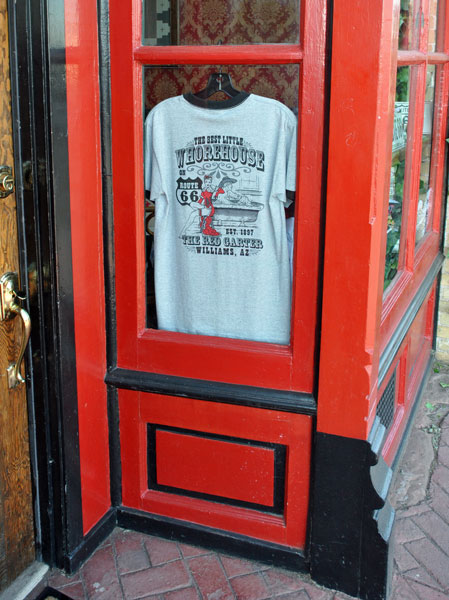
Coming into town on Bill Williams Avenue (Route 66), we stopped at the Red Garter Bed & Bakery. A former saloon and bordello built in 1897,  this 2-story Victorian building is right across the street from the Grand Canyon Railway train which takes visitors to and from the Grand Canyon every day. After a nice cup of coffee and a cinnamon bun, it was fun to browse the t-shirts and books for sale. One colorful t-shirt in particular caught my eye ("Best little Whorehouse on Route 66 - The Red Garter, but unable to think of a single place I could wear it, I didn't buy it. The books were interesting - "Bad Girls of the American West," "The Bedside Book of Bad Girls," "Soiled Doves," and "High Spirited Ladies" were just some of the titles. OK, yes, I did glance through them, but I didn't buy any books either.  I did, however, manage to find out some interesting history.

Red Garter t-shirt - "Best Little Whorehouse
on Route 66"


Built in 1897, the building had a saloon on the first floor and 8 cribs (bedrooms) upstairs - one for the madam and 7 for the "working girls." There was also a small parlor for the girls to wait for a client on a slow night or for gentlemen clients who might have to wait their turn on a busy night. Catering to cowboys, miners, lumbermen and railroad workers, the girls, when not engaged in entertaining a customer, would hang out of the 2nd floor windows, giving the passing men below a little glimpse of what they had to offer and enticing them to come inside for a drink or two and then to spend a few minutes upstairs.

Arizona outlawed prostitution in 1907, but enforcement of that law was not vigorous. As a matter of fact, the saloon and bordello continued to do a booming business until the mid-1940's. Fighting in WWII took away most of the Red Garter's customers and then, some poor guy was murdered on the stairs in the building. The murder led to a crackdown on saloons and prostitution in Williams and with the lack of available customers anyway, the Red Garter shut its doors.  A general store and a rooming house did business in the old building until it was purchased by John Holst in 1979. He leased it out to a variety of businesses until he decided to completely refurbish the building and open the Bed & Bakery himself in 1994. The 8 small rooms and parlor upstairs have been converted into 4 larger rooms, each with its own bathroom. With names like "Best Gal's Room," "Big Bertha's Room," and "Madam's Room,"  they are available for about $125 - $160 per night. Showing a wry sense of humor, the establishment proclaims, "Celebrating over 100 years of personal service."

Interesting and humorous t-shirts and books in the Red Garter
With this building's history, you will probably not be surprised to learn there is also a resident ghost that visitors have persistently reported. Footsteps in the hallway when nobody is there, doors slamming in rooms that nobody is in, and even indention's in the beds, like someone sitting on the edge of the mattress, that appear and then disappear have all been repeatedly reported to Mr. Holst. A few people have even claimed to see the ghost - an Hispanic girl with long dark hair wearing a white nightgown and holding something in front of her (nobody has been able to tell what she is holding). Her name is Eve or Eva and if you ask Mr. Holst, he'll show you a very old photograph taken inside the Red Garter. In the photo are members of the Mora family who owned the saloon for many years and a suspiciously smiling, mysterious dark-haired Hispanic girl in the background standing in front of a mirror. The only thing off is the girl's reflection - it does not show up in the mirror. I just may have added to my Bucket List. One of these days, I would really like to come back here, stay for a few days at the Red Garter and take the train to the Grand Canyon. Now I just have to decide when and which lady's room my wife and I will stay in!

Twisters 50's Diner
Just around the corner from the Red Garter was our next stop - Twisters 50's Soda Fountain. This is one of the closest things to a true 1950's diner that you'll find. From the Cherry or Vanilla or Chocolate flavored Cokes to old-fashioned ice cream soda's to charbroiled burgers, hot dogs and chili dogs, to the 50's music that continuously plays, the food and the atmosphere are definitely rooted in the past. Well, except for the steaks and beers and wine they serve at dinner. I don't recall any diner I remember from way back when serving microbrewery beer! This place has consistently been voted one of the top 25 restaurants in Arizona. Sounds like a great place for dinner after returning from a day exploring Grand Canyon. Adding details to that Bucket List item!

After cruising around Williams for a while, we headed on down the road. Next stop - the Road Kill Cafe and the famous and quirky little town of Seligman.


Go to the first Route 66 entry here.
Or go to the first entry of each state: